
 EN
EN



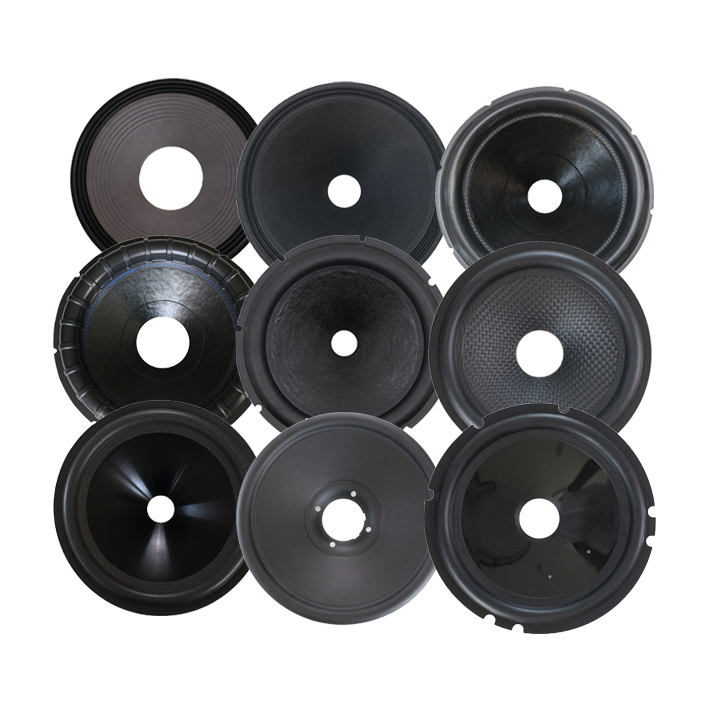
How the Diaphragm Converts Electrical Signals into Sound Waves
The role of the diaphragm in sound wave production
At the heart of every speaker sits the diaphragm, which turns electrical signals into actual movement that makes sound happen. As audio travels through the voice coil connected to this component, it interacts with magnets inside the speaker, causing it to move back and forth really fast. This movement pushes around air particles, making those pressure changes we hear as sounds within our hearing range of roughly 20 Hz all the way up to about 20 kHz. Some studies last year showed that when manufacturers get the balance right between how stiff and heavy a diaphragm is, they can hit nearly perfect harmony below 1 kHz mark, which means bass notes come out much clearer and truer to what was recorded originally.
Pistonic movement and signal transduction in dynamic drivers
Dynamic drivers depend on what's called pistonic motion for clear sound quality. Basically, this means the diaphragm moves straight back and forth without any wobbling or warping that could mess up the audio. When the voice coil interacts with the magnetic field inside the driver, it creates force that matches whatever signal comes in from the source. This lets manufacturers control how the cone moves pretty precisely. According to recent research from the Audio Engineering Society (2023), today's best drivers can keep piston movement within about half a tenth of a millimeter for every watt they receive. What makes these moving coil systems so special is their ability to handle really high frequencies too. Some top tier tweeters can reach beyond 40 kHz while still maintaining low distortion levels around 0.5% even when playing loud at 90 decibels. That combination of performance across different conditions is why audiophiles continue to prefer them despite newer technologies entering the market.
Case study: Diaphragm behavior across frequencies in real-world speakers
Tests indicate that aluminum dome tweeters can maintain pistonic movement all the way to around 15 kHz, beating out paper cones that usually start to distort somewhere near 8 kHz. Dome shaped midrange drivers also show about 18 percent better dispersion at 2000 Hz when compared against traditional cone designs, which makes them much clearer even when listening from angles off center. According to findings published in last years Loudspeaker Materials Report, this explains why serious audio equipment manufacturers carefully select different diaphragm materials and shapes depending on what part of the sound spectrum they need to cover effectively.
Advancements in precision motion for high-fidelity audio reproduction
Recent innovations have significantly improved diaphragm performance:
- Plasma-treated polymer composites reduce mass by 22% while increasing rigidity
- 3D-printed diaphragms with variable thickness raise high-frequency breakup thresholds by 37%
- MEMS-based micro-speakers achieve 150dB/W efficiency via nanoscale piston control
These developments allow THX-certified systems to maintain frequency response within ±1dB of reference levels—a 60% improvement over 2018 models—enabling studio-grade fidelity in consumer audio.
Diaphragm Materials: Balancing Stiffness, Weight, and Damping for Optimal Performance
Common Materials Used in Speaker Diaphragms and Their Acoustic Properties
The best speaker diaphragms need to strike a tricky balance between being stiff enough, light as a feather, and having good internal damping properties. Paper pulp is still pretty common for midrange drivers because it naturally dampens vibrations and doesn't weigh much at all (around half a gram per cubic centimeter). When manufacturers want something even stiffer but not heavier, they turn to cellulose mixed with polypropylene which gives about 40 percent more rigidity. For those high frequency tweeters, most companies go with aluminum or titanium since these materials pack a lot of stiffness into relatively small packages (typically between six and ten gigapascals). But there's a catch these metals can start ringing if left unchecked, so many modern designs incorporate special viscoelastic coatings on the surface to kill unwanted resonances and keep the sound clean across the entire frequency range.
| Material | Stiffness | Weight | Damping | Common Application |
|---|---|---|---|---|
| Aluminum Alloy | High | Medium | Low | Tweeters, Horn Drivers |
| Polypropylene | Moderate | Low | High | Midrange Woofers |
| Titanium | Very High | Medium | Low | High-End Tweeters |
| Fiber-Reinforced | Custom | Low | Medium | Full-Range Drivers |
Material Impact on Frequency Response and Overall Speaker Performance
The Young's modulus of a speaker diaphragm basically tells us how resistant it is to those breakup modes we all know about frequencies where vibrations get out of control and create distortion problems. Boron reinforced aluminum keeps that pistonic action going until around 8 kHz mark, which means less intermodulation distortion for woofer drivers. The story changes when looking at softer stuff like polypropylene though these tend to lose their grip smoothly after hitting about 3 kHz. Recent findings from last year's Loudspeaker Materials Research show something interesting too magnesium diaphragms coated with graphene cut down on third harmonic distortion by nearly 18 percent compared to regular alloys. This shows just how much difference surface treatments can make in getting better sound quality from our speakers.
Trade-Offs Between Stiffness, Damping, and Mass in Diaphragm Design
The classic problem designers run into is finding the right balance between stiffness and weight. When they try to make something stiffer, it usually gets heavier too, which messes with how quickly it responds. On the flip side, adding more damping tends to make materials feel softer overall, cutting down on performance. Some clever approaches have emerged though. Sandwich structures with carbon fiber outer layers and Nomex in the middle offer impressive results, hitting around 500 MPa stiffness while keeping density low at only 1.2 g/cm³. That's actually about 60% better than regular paper cones used in many applications. Another trick up the sleeve is asymmetrical damping layers that help control those annoying breakup modes without sacrificing much sensitivity. These designs typically maintain sound levels between 85-90 dB/W/m, so speakers stay clear and efficient even when pushed hard.
Cone vs. Dome Diaphragms: Design Differences and Application Use Cases
Functional differences between cone and dome diaphragm configurations
Cone diaphragms work really well for moving air efficiently at lower and middle frequency ranges. Their design incorporates a tapered shape that helps extend the piston-like movement down past around 2 kHz. These cones are typically made from stuff like aluminum reinforced polypropylene material which has certain mechanical properties making it suitable for this application. The Young's modulus is somewhere between 3 to 5 GPa and damping factor sits around 0.02 to 0.04. This combination gives good bass output without too much unwanted resonance. Dome shaped diaphragms take a different approach altogether. They rely on their curved profile to stay rigid when handling those higher frequency sounds. Sizes usually range from about 25mm up to 38mm across, which makes them great for spreading sound out above 2 kHz. Take beryllium domes as a prime example. These can handle frequencies way beyond 35 kHz before breaking up, and they weigh roughly 42 percent less than similar sized aluminum ones. That weight difference matters a lot for keeping details clear and response fast in tweeter applications.
How multi-driver systems utilize different diaphragm types by frequency range
Three-way speaker systems combine cone and dome drivers to cover the full audible spectrum efficiently:
- Woofers (40Hz–500Hz): 165mm–300mm cones manage large air volumes
- Midranges (500Hz–4kHz): 75mm–130mm cones or specialized domes handle vocal and instrumental ranges
- Tweeters (4kHz–20kHz+): 25mm domes with ferrofluid cooling reproduce highs with <0.3% THD at 90dB SPL
This approach leverages each diaphragm type’s strengths, supported by advanced crossover networks (24dB/octave slopes) that ensure seamless transitions and phase coherence within ±30° across frequencies.
Engineering Challenges in Minimizing Distortion and Maximizing Audio Fidelity
The Role of Stiffness and Damping in Reducing Harmonic and Intermodulation Distortion
The relationship between stiffness and damping plays a key role in controlling distortion. Materials that are stiff, such as carbon fiber composites, simply don't bend as easily which helps cut down on those pesky third order harmonics by about 40 percent according to research from AES back in 2022. But there's a catch when things get too stiff. Excess rigidity actually creates problems with nonlinear vibrations and tends to boost intermodulation distortion instead. That's where viscoelastic damping comes into play. These special layers soak up leftover energy while still keeping the system responsive enough for good performance. When manufacturers balance both aspects properly, they end up with diaphragms that stay under 0.5% total harmonic distortion even when pushed hard at around 100 decibels output level.
Understanding Speaker Break-Up Modes and Their Impact on Sound Clarity
When parts of a speaker's diaphragm start vibrating on their own, we get what engineers call break-up modes. These usually happen around 2 to 8 kHz range in standard 6 inch drivers and can create serious problems in sound quality, sometimes dropping response levels by as much as 12 dB according to research from JAES in 2021. To spot where these issues might develop, manufacturers often turn to finite element modeling techniques. This allows them to see problem areas and then make changes to the driver design. Some common fixes include adding ribs to the surface or varying how thick different parts of the cone are. Take subwoofers for example many companies have found that changing from round edges to oval shaped ones cuts down on those annoying break-up distortions by about 31 percent over conventional designs. Makes sense really since the shape affects how vibrations travel across the material.
How Diaphragm Geometry Affects Transient Response and Sound Dispersion
The shape of components makes all the difference when it comes to how well they perform. Research published in the Journal of Audio Science and Applications back in 2023 showed that cones shaped like hyperbolic curves boost transient response by around 22% compared to flat ones because they distribute mass and stiffness better across the surface. Tweeters with curved domes spread sound out horizontally across 180 degrees with minimal variation (just +/−1.5dB), which is really important if we want listeners to hear the same quality no matter where they sit. All these small improvements let speaker diaphragms pick up on those tiny details in music, like the exact moment a piano hammer hits the string, even when those sounds last only 2 milliseconds. And despite all this attention to detail, the speakers still manage to cover a decent area without losing any of their clarity.
Innovations Addressing Diaphragm Limitations in Premium Audio Systems
Cutting-edge developments continue to push performance boundaries:
- Metamaterials with tunable stiffness gradients extend frequency linearity by 57%
- Laser-interferometry-optimized corrugation patterns suppress breakup modes
- AI-driven topology optimization achieves 98% pistonic motion up to 40kHz
These breakthroughs overcome traditional material limits, allowing high-end speaker diaphragms to match the clarity and dynamics of live acoustic performances (Harmon 2023 Market Report).
FAQ Section
What is the diaphragm's main purpose in a speaker? The diaphragm transforms electrical signals into sound waves through its movement, pushing air particles and creating pressure changes we perceive as sounds.
What are pistonic movements in dynamic drivers? Pistonic movement refers to the diaphragm's direct back-and-forth action without wobbling or warping, ensuring clear audio quality.
Why is diaphragm material important? Diaphragm material affects stiffness, weight, and damping, which all play crucial roles in sound clarity and performance across varying frequencies.
What are the differences between cone and dome diaphragms? Cone diaphragms efficiently move air at lower frequencies, whereas dome diaphragms maintain rigidity for higher frequency sounds and better sound dispersal.
What are some recent advancements in speaker diaphragms? Innovations include plasma-treated composites, 3D-printed diaphragms, and MEMS-based micro-speakers, significantly enhancing performance and fidelity.
Table of Contents
- How the Diaphragm Converts Electrical Signals into Sound Waves
- Diaphragm Materials: Balancing Stiffness, Weight, and Damping for Optimal Performance
- Cone vs. Dome Diaphragms: Design Differences and Application Use Cases
-
Engineering Challenges in Minimizing Distortion and Maximizing Audio Fidelity
- The Role of Stiffness and Damping in Reducing Harmonic and Intermodulation Distortion
- Understanding Speaker Break-Up Modes and Their Impact on Sound Clarity
- How Diaphragm Geometry Affects Transient Response and Sound Dispersion
- Innovations Addressing Diaphragm Limitations in Premium Audio Systems
- FAQ Section