
 EN
EN



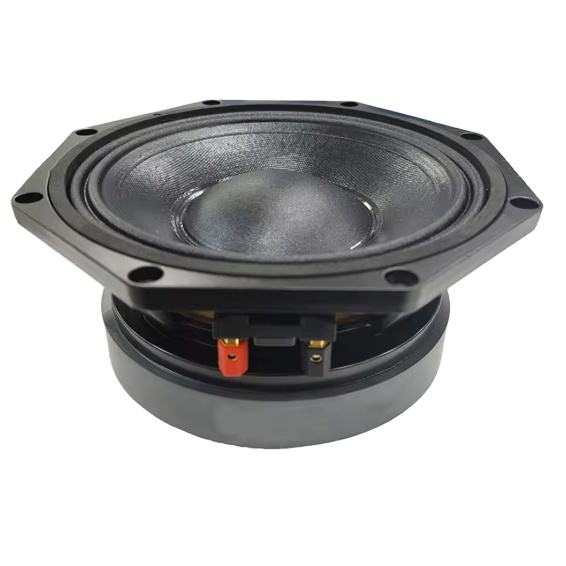
The Core Physics: How Woofer Speakers Generate Low Frequencies
Diaphragm Excursion, Air Displacement, and Wavelength Requirements (20—100 Hz)
Getting good bass reproduction requires woofers to move large amounts of air across significant distances in their diaphragms. At 20 Hz, sound waves stretch out to around 17 meters or 56 feet long, which means speaker cones have to move much further back and forth compared to those handling higher frequencies. The actual movement of these cones creates the pressure changes needed for those deep low-end sounds we hear. Take 30 Hz at 90 dB volume level as an example case study it needs about three to four times more cone motion than what's required for midrange frequencies. When dealing with frequencies below 50 Hz where wavelengths go beyond 6.8 meters (roughly 22 feet), manufacturers need special designs like extended throw voice coils and stronger suspension systems just to keep things linear. If there isn't enough control over how far the cone moves, the bass gets compressed and starts introducing unwanted harmonics that ultimately make the overall sound quality worse.
Why Larger Cones and Stiffer Suspensions Are Essential for Woofer Speaker Performance
Bigger speaker cones, usually between 8 to 15 inches across, can push more air while moving less distance overall, which is really important when it comes to getting good bass response. When manufacturers double the size of these cones, they actually get four times as much surface area working against the air, so the cone doesn't need to travel nearly as far to produce the same volume level. Stiffening up those suspension parts around the edge of the cone (what we call surround and spider assemblies) helps tackle several big problems at once. First off, it keeps control over how hard the cone swings back and forth during operation. Second, it stops the voice coil from shifting out of place within its magnetic field. And finally, this stiffness prevents damage from happening when the cone moves too far beyond what's safe for the driver, especially when operating below its natural resonance point.
| Design Factor | Physics Rationale | Performance Impact |
|---|---|---|
| Large Cone | Reduced excursion per decibel output | Lower distortion + higher power handling |
| Stiff Suspension | Faster cone restoration | Tighter transient response + reduced ringing |
Rigid materials like polypropylene or aluminum resist flexing during high-excursion cycles, ensuring pistonic motion. This synergy enables accurate, undistorted bass down to 20 Hz without mechanical failure.
Key Design Elements That Enable Accurate Woofer Speaker Output
High-Force Motor Structures and Long-Throw Voice Coils
Getting good bass down low really comes down to having solid motor systems in place. These days, most speakers use those powerful neodymium magnets that create super strong magnetic fields. Pair that with big voice coils that can move anywhere from 15 to 30 mm linear distance and they push way more air without warping the sound. What this does is keep the speaker cone moving just right even when it's stretched to its limits, so we don't get that unpleasant bottoming out effect when music gets loud. A recent study showed these kinds of setups cut down on harmonic distortion by around 40% compared to regular old woofers. Heat management matters too though. Manufacturers often go for copper clad aluminum voice coils and include vents in the pole pieces to let heat escape properly. This helps maintain quality sound levels even after hours of continuous playback without things getting too hot inside the speaker cabinet.
Cabinet Acoustics: Sealed, Ported, and Passive Radiator Enclosures
What kind of enclosure we use makes all the difference when it comes to how a woofer handles bass and overall performance. Sealed boxes give us that clean, precise bass sound with a natural drop off at lower frequencies, but they need quite a bit more power from the amp to work properly. Ported enclosures go further down in frequency range because of those special vents inside that are carefully adjusted for specific sounds. However, if these vents aren't set right, we might end up hearing annoying chuffing noises instead of smooth bass. Another option worth considering is passive radiators. These systems get rid of the vent noise problem completely while still managing to reach those deep bass notes through specially designed diaphragms that don't require any electrical power themselves.
| Enclosure Type | Frequency Extension | Group Delay | Ideal Use Case |
|---|---|---|---|
| Sealed | Moderate (30—40 Hz) | <10 ms | Critical listening |
| Ported | Deepest (20—30 Hz) | 15—30 ms | Home theater |
| Passive Radiator | Deep (22—35 Hz) | 10—20 ms | Compact systems |
Advanced materials like constrained-layer-damped MDF reduce cabinet resonance by 60%, while internal bracing suppresses sound-coloring vibrations (Acoustical Society of America, 2024). Properly engineered enclosures ensure phase coherence and minimize standing waves—enabling seamless integration with satellite drivers.
Human Perception and Real-World Behavior of Woofer Speaker Bass
Tactile Sensation vs. Auditory Detection: Why Low Frequencies Are Felt More Than Heard
The way humans experience bass frequencies between 20 and 80 Hz is quite different from our perception of mid and high range sounds. When frequencies drop below 50 Hz, the actual sound waves start vibrating not just our ears but also our skin, internal organs, and bones themselves, creating a physical feeling that can be measured. That's why when watching movies with big explosions or listening to those really deep electronic beats, people often feel the rumble in their chests long before they actually hear the sound. Studies show something interesting too: it takes about 15 to maybe even 20 decibels more power for us to notice a 30 Hz tone compared to regular midrange frequencies. Because of this, a lot of what makes woofers so powerful doesn't actually register in our conscious hearing at all. Instead, these low frequencies connect with us emotionally and physically through the vibrations they create in our bodies, rather than just stimulating our eardrums like normal sounds do.
Directionality Myth: How Wavelength Dominance Reduces Woofer Speaker Localization
When we talk about sound waves under 100 Hz, they stretch out over 11 feet long, which is actually longer than many rooms themselves. These big waves just go right around anything in their path and spread through spaces pretty evenly, making what's called pressure fields all over the place. Our brains figure out where sounds come from using those high pitch timing differences between our ears, but low frequency stuff doesn't give us those clues. That's why people generally can't tell exactly where a subwoofer is sitting, even when there are several in the same room together. The reason bass seems to come from everywhere at once instead of pointing in any particular direction has to do with these long wavelengths. They just bounce around and settle into the space rather than shooting straight ahead like higher frequencies do.
| Perception Factor | Frequency Range | Human Detection Method | Localization Ability |
|---|---|---|---|
| Tactile Bass | 20—50 Hz | Body vibrations | Not applicable |
| Auditory Bass | 50—100 Hz | Ear detection | Minimal (<5° accuracy) |
| Mid/High Frequencies | >200 Hz | Pinna/ear canal cues | High (1—3° accuracy) |
FAQ
Why are larger cones essential for woofers?
Larger cones can push more air while moving less distance, which is vital for good bass response and reduces distortion.
What role does a stiff suspension play in woofer performance?
A stiff suspension helps control cone movement, prevents voice coil displacement, and avoids damage, especially below natural resonance points.
Why do we feel low frequencies more than we hear them?
Low frequencies vibrate our body and internal organs, creating physical sensations that are often more perceptible than the actual sound.
What are the differences between sealed and ported enclosures?
Sealed enclosures provide precise bass and need more power, while ported enclosures can extend frequency range but require careful tuning.